


Page 4 - MarchApril26 Report
P. 4
president’s brief
Choosing
Inclusion in the
Legal Profession
Imagine practicing law without sight or hearing. Haben
Girma doesn’t have to imagine. Born Deafblind, she gradu-
ated Harvard Law School and then litigated before becoming
a full-time advocate for inclusion. At her website, habengirma.
com, you can see her global impact, as recognized by Presidents
and leaders across many sectors.
I had the privilege of hearing Ms. Girma speak in December
at the Fifth Third Bank Leadership Symposium, hosted by the
Cincinnati Regional Chamber. Each year, scores of leaders from
the Cincinnati business community attend the symposium to
discuss inclusion and belonging as a driver of good business and
regional progress. Cincinnati’s largest employers are in that room,
looking for better ways to do business and improve where they
and their workforce live. It is a serious exercise.
As I contemplated a topic for this, my final President’s Brief,
Ms. Girma’s message resonated deeply. She spoke not of over-
coming her disability, because she will always be Deafblind. That
is not her barrier. Her barrier is the ableism that presumes her to
be incompetent, or that fails to value her competencies because
of her disability. It is the ableism that ignores what nondisabled
people fail to do as well as she does, or the accommodations they
need, simply because she presents differently.
Let me add, on a more fundamental level, the barrier of not
valuing people simply for the human beings they are, regardless of
their abilities or whether they make a dime for anyone.
As a society, we can remove such barriers. Not doing so is a
choice. We can also do our part as a profession. Later in these
pages, we feature one example set by a law firm that stepped out of
a typical comfort zone to hire someone with a disability, and the
employee who rewards the firm for that choice every day. Progress
begins at home. It is striking to contemplate the benefits missed
by businesses not being bold enough to make similar decisions.
In the same vein, we feature stories of access to justice through
the lens of other local organizations. This is the notion that anyone
with a legal problem deserves the help they need to participate
fairly in our justice system. It is equally striking to contemplate
the dignity and efficiency lost by not making such resources avail-
able more widely.
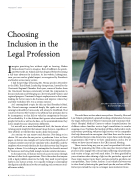
Alan Abes is a partner at Dinsmore and
the 2025-2026 CBA president.
We could have written about many others. Recently, Harvard
Law School spotlighted a groundbreaking collaboration between
the Legal Aid Society of Greater Cincinnati and Cincinnati Chil-
dren’s Hospital Medical Center to reduce hospitalizations for
children whose families receive legal consultation to resolve
ongoing crises. Pro Bono Partnership of Ohio celebrated its tenth
anniversary providing volunteer legal services to the nonprofits
that help thousands in our region. And then there are the stories
of individual lawyers who devote time to pro bono work through
organizations like VLP or to their communities, only a few of
whom we have time to honor at the CBA Annual Meeting.
These stories bring my year as your bar president full circle.
I began by promoting the CBA as the one place lawyers from all
practice areas engage with critical topics affecting our profession
and society at large, and with each other. I’ve been gratified by
your attention when shining a light on the particular aspects of
those topics nearest to my heart, and am excited to go where our
next president, Terry Coates, leads us. I can’t think of a better way
to close than by featuring the good work you do, and can still do,
for lawyers to lead the way to a stronger, more inclusive future.
4 | march/april 2026 cba report


