


Page 4 - JanuaryFebruary26 Report
P. 4
president’s brief
Be Kind.
Be kind. Many CALL classes heard a prominent local judge
describe that as the most important characteristic to display on
the bench, and for lawyers to display in his courtroom.
Note that he did not say, “be weak.” Nor did he say, “be inef-
fective.” He certainly isn’t. His message was that being an effective
decision-maker or advocate does not require acting in ways we
would not otherwise tolerate of ourselves or others. Bullying and
unpleasantness are not job requirements. Consideration, decency,
and empathy have their place among competitors. Being mean
does not make us more tough or tenacious.
Experience teaches that inconsiderate behavior is not only
wrong, but terribly counterproductive. We do not serve our clients
when behavior obscures our message or when we lack the trust to
communicate across the table persuasively. We do not serve our
clients or ourselves by squandering goodwill and burning bridges.
Chances are high that you agree. Cincinnati’s bar has a
well-deserved reputation for collegiality. It would be naive to
think we lack outliers. Having litigated in many other jurisdic-
tions, however, I will attest that the Cincinnati bar is special.
This is no accident. We teach the next generation. Nothing
leaves a greater impression on a newer lawyer than the example
of a mentor or an adversary extending a courtesy, refusing to take
unwarranted advantage, or acting respectfully in the heat of a
tough negotiation or dispute.
Not surprisingly for this space, we also have a bar associa-
tion that organizes around such principles. We honor exemplars
at every Annual Meeting with the John P. Kiely Professionalism
Award. In the following pages, you will read about a few ways we
foster civility, professionalism, and ethics every day. You will also
read about how we go further through programs like Lawyers
Connecting Beyond the Law that, like CALL, build personal
connections among lawyers that would not exist but for these
efforts.
These are high value propositions for our community and
the individual lawyers the CBA serves. They are the intangible
building blocks that pay in tangible ways over the course of a
career.
All of us must keep Cincinnati’s legal culture thriving. It
takes vigilance. We have seen far too often in the wider world that
important norms and institutions once taken for granted erode
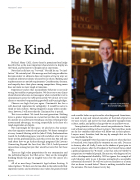
Alan Abes is a partner at Dinsmore and
the 2025-2026 CBA president.
and crumble before we quite realize what happened. Sometimes,
we need to stop and remind ourselves of the kind of practice
we want to have, and not let the least admirable examples from
culture, media, and politics change who we are and how we act.
I am optimistic we will take care of our profession in Cincin-
nati without succumbing to baser instincts. The trend lines make
me far less confident that others will follow suit in their spheres.
Lawyers must, therefore, lead the way by example that sets the
tone and holds the line.
We are equipped better than most to speak out when that line
is breached, even (especially) by someone on our side. Decency
is decency, after all. Sadly, I write in the shadow of great pain in
one of my spheres after the President of the United States called
a political opponent the “R-word,” a slur that seeks to belittle by
comparison to wonderful people, like my son, who happen to live
with a developmental disability. Will we ignore the example of
such behavior, only to see it become normalized as acceptable
adversarial discourse? Or will we insist on kindness as a norm
that we know to work better? There is nothing inevitable about
the outcome. We must choose it every day.
4 | january/february 2026 cba report


