


Page 6 - JanuaryFebruary26 Report
P. 6
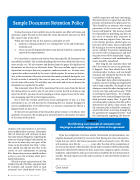
Sample Document Retention Policy
During the course of our work for you on this matter, our office will create and
maintain a paper file and an electronic file. Some documents may exist in both
files, some in one or the other.
When our work for you on this matter is concluded, we will:
1. send you a "closing statement" or a "closing letter" at the end of the repre-
sentation; and
2. return to you all original documents you have provided to us during the
course of the representation.
It is our policy to remove and destroy from the paper file all documents that
are publicly available. This includes pleadings that have been filed with the court,
news articles, etc. We also remove and destroy from the paper file duplicates of
documents we also have in electronic form. This may include expert reports,
deposition transcripts, discovery responses, medical records, etc. In some cases,
a protective order is entered by the court, which requires the return or destruc-
tion, at the conclusion of the case, of certain documents produced during the case.
If such an order is entered by the court in your case, you will be made aware of
it at the time of the order. We will obey any such order and return or destroy the
documents as required by the order.
The remainder of our file will be maintained for seven years from the date of
the closing letter we send to you. If you want to review the file or obtain a copy
of part or all of it, you may do so by sending a written request to one of the attor-
neys managing your file or their legal assistants.
On or after the seventh anniversary of our closing letter to you, at a time
convenient to us, we will destroy the remaining file in a manner designed to
ensure confidentiality. If we believe there is a reason to maintain the file for a
longer period, we may do so.
If you have any questions about this policy, please contact us to discuss your
questions or concerns. By accepting our representation in this matter, you agree
to the terms of this policy.
could be expensive and time-consuming.
One alternative is to agree that one of the
partners will maintain the physical server.
This should be an attorney who retains
possession of the server, not a non-at-
torney staff member. The attorney would
be responsible for providing any files on
the server to former firm attorneys or
clients who may request them. The soon-
to-be former partners should agree on
how this will be done, who is responsible
for sharing in the cost of maintaining the
server, whether the partner maintaining
the server will be compensated, and how
long the server will be maintained.4 Again,
conflicts of interest and confidentiality
issues should be considered.
How long do you maintain those old
files? As is often the case in our profession,
it depends. Your firm should have a file
retention policy in place, and you should
maintain and ultimately destroy the files
in accordance with that policy.
If you don’t have a file retention policy
in place, you must develop and implement
one as soon as possible. The length of time
attorneys retain files after closing tends to
vary by case type and practice area.5 Wills
or prenuptial agreements, for example,
may need to be retained longer than stan-
dard personal injury files. A good file
retention policy indicates that files will be
destroyed at (or after) a date certain. The
file retention policy should be communi-
cated to the client, in writing, through the
fee agreement or engagement letter.6 And
the information regarding file destruc-
The following is an example of commonly used
language in an initial engagement letter or fee agreement:
conflicts with client matters at new firms
and confidentiality concerns. Remember
that all attorneys will continue to have
the same ethical obligations regarding the
attorney-client privileged information on
the server as when they were part of the
(soon-to-be-dissolved) law firm.3 Attor-
neys should not add any new files to the
server, or new information to existing
files. Former law partners should not have
access to any new attorney-client privi-
leged information.
What if you have a physical server? You
could review all of the files, segregate them
by attorney, and transfer them to each
attorney’s new cloud-based server. This
6 | january/february 2026 cba report
Upon the completion of services and/or termination of representation, any
original documents provided by you to the firm during the course of represen-
tation that are still in the firm’s possession will be returned to you. The firm
will maintain your file for ________ years after the date of the completion of
services in this matter. After that date, the file and its contents will be permanently
destroyed. Client hereby releases the firm, its partners, assignors, agents, servants,
employees, representative and successors from any liability for the destruction of
said file. You may request your file and its contents at any time before the date of
destruction.
____________
Client Initials


